
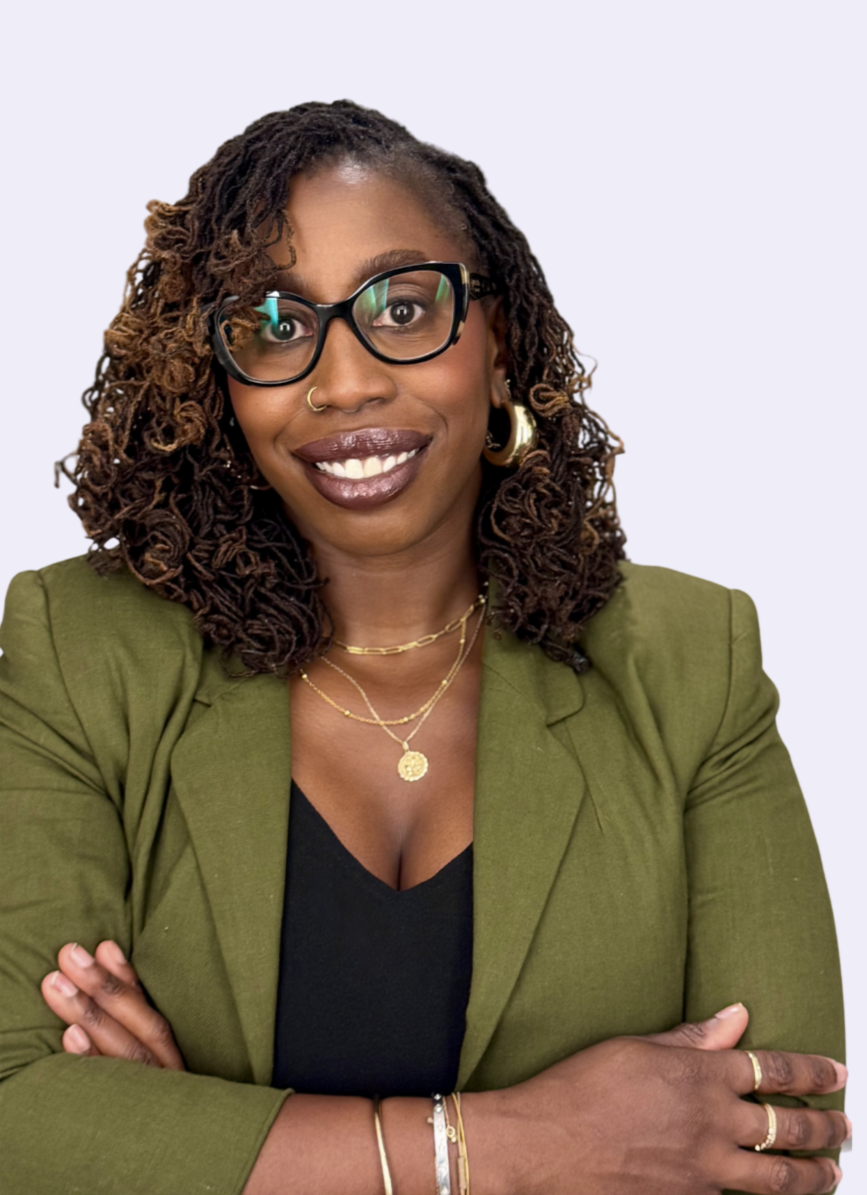
About Deandra Christopher, MEd
Deandra Christopher, MEd, designs the conditions that let people do their best work across post-secondary accessibility, work-integrated learning (WIL), and employer systems that were not always designed with different ways of thinking, learning, and communicating in mind.
She started in rehabilitation therapy, then spent more than a decade in ABA therapy, autism intake, and family support at a nonprofit agency, experience that shaped how she thinks about environments, not just individuals. From there she moved into accessibility and WIL roles at Sheridan College and George Brown Polytechnic, where her focus shifted to how inclusion actually functions in practice, not just in policy.
Her MEd research at Ontario Tech University examined Universal Design for Learning in non-traditional post-secondary contexts. That work sharpened a career-long question: what do inclusive systems need to do differently when real students, real placements, and real institutional processes are involved?
That question led to a practice-based model for embedding accessibility across the WIL landscape, published and presented at WIL'25 in Oslo in 2025. She has also presented on inclusion and WIL provincially, nationally, and internationally.
Through VELA, Deandra brings this experience to post-secondary institutions, employers, nonprofit organizations, and the individuals and families navigating them. Her approach draws on trauma-informed practice, Applied Behaviour Analysis, adult learning theory, the Social Model of Disability, and ontological inclusion. The work stays individualized and strengths-based while looking beyond the person alone to consider the environments, expectations, and systems around them.
Whether she is supporting a family preparing for a post-secondary transition or an institution building a more inclusive WIL program, the question is the same: what could be designed differently, and who else needs to be at the table?
Language and practice
VELA works across both registers, the identity and community language of neurodivergence, and the legal and policy language of disability. The people we work with live in both realities at once. That is not a contradiction. It is the landscape.
Deandra’s research uses the precise language of institutional frameworks where the context requires it. Her coaching and consulting practice centres the language of identity, agency, and strengths.
What that means
Institutional clients work with a consultant who understands the individual experience from the ground up, not just the policy, but what it actually feels like to navigate a system that was not designed for you.
Individual clients and families work with a coach who knows how the systems work from the inside out, what institutions are required to provide, where the gaps are, and how to navigate them.
Speaking and professional development
Deandra speaks to WIL practitioners, accessibility professionals, institutional leaders, and employers. Her presentations draw on published research and almost two decades of direct clinical and institutional practice. The goal is simple: people leave with something they can use immediately.
Topics
Neurodiversity and WIL: what the evidence says and what practitioners need to do differently
Autistic burnout in educational and workplace settings: recognition, prevention, and what institutions and employers can change structurally
Universal Design for Learning in non-traditional post-secondary contexts: where implementation gaps persist and what actually closes them
Disclosure and accommodation: what neurodiverse students and employees need at each transition point and why current processes often fail them
AI and assistive technology: practical, ethical considerations for practitioners, WIL coordinators, and employers
Strengths-based approaches to neurodiverse inclusion in WIL and workplace settings
Past engagements
Universal Design Symposium at Munster Technological University (MTU), Kerry, Ireland, June 2026
ABA Jam 2026, Toronto, Canada
WIL25 International Conference, Oslo, Norway, September 2025
Co-operative Education and Work-Integrated Learning Canada (CEWIL), Niagara, Canada, June 2025
Experiential & Work Integrated Learning Ontario (EWO), Virtual, November 2024
Available for
Institutional professional development days
National and international conferences
Employer panels and DEI training days
WIL practitioner training sessions
Community and family-facing events
Credentials
Master of Education and Technology (MEd), Ontario Tech University, 2021
Peer-reviewed publication and presentation, WIL25 International Conference, Oslo, 2025
Peer reviewer, WIL25 proceedings